


AI + Quantum Rewrite North America’s Waste Economy
Author: Dave Gajadhar Resultant Group
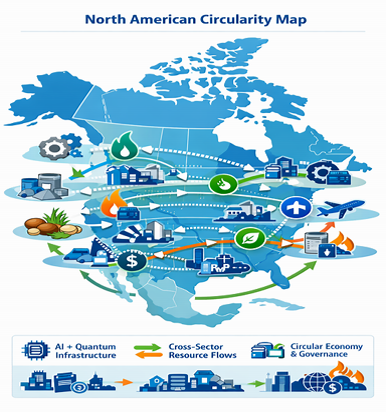
North America is approaching a structural shift that will redefine what we call “waste.” For decades, the industry operated on a linear model — collect, haul, bury, burn. That model is now collapsing under regulatory pressure, rising costs, aging infrastructure, and a public that demands circularity, transparency, and measurable environmental value.
AI and quantum computing are about to flip the script.
Waste is no longer a liability. With AI and quantum, waste becomes a resource ledger.
This brief is engineered for C‑suite leaders, regulators, investors, and operators who must understand how the next decade will reshape the economics, governance, and operating models of waste management across North America.
The Industry’s Inflection Point
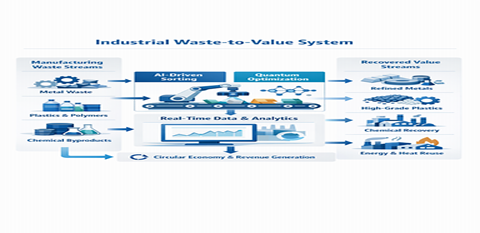
Waste management is shifting from a back‑office utility to a strategic pillar of national competitiveness, climate resilience, and industrial supply chains.
Three forces are converging:
- Regulatory pressure: EPR, carbon pricing, methane reporting, PFAS tracking, landfill diversion mandates
- Economic pressure: Rising landfill costs, volatile commodity markets, demand for new revenue streams
- Technological pressure: AI, sensors, robotics, and quantum computing enabling real‑time material intelligence
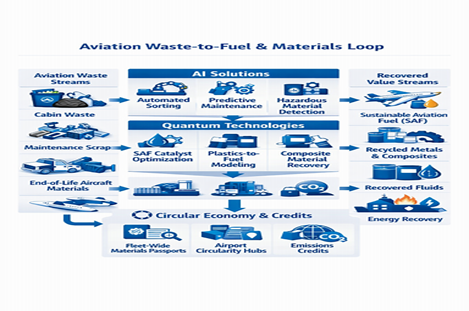
AI: The New Operating System for Waste Intelligence
“The companies that win will be the ones that waste nothing.”
AI is already reshaping the sector, but the next five years will deliver a step‑change in capability.
A. Real‑Time Material Identification
Computer vision + robotics deliver:
- Automated sorting with 95%+ accuracy
- Resin‑level plastic identification
- Detection of contaminants invisible to humans
- Real‑time quality grading for recyclables
“Every piece of waste becomes a data point — and data points become dollars.”
B. Predictive Waste Streams
AI models forecast:
- Volume surges by neighborhood, sector, or event
- Composition shifts driven by consumer behavior
- Seasonal and economic patterns in material flows
This enables optimized routing, staffing, and processing.
C. Methane, Leachate & Emissions Monitoring
AI‑driven sensors and drones detect:
- Methane leaks in real time
- Leachate migration
- Temperature anomalies indicating fire risk
Punchline: “AI turns landfills from black boxes into transparent, auditable assets.”
D. Dynamic Pricing & Resource Monetization
AI can price:
- Recyclables based on global markets
- Organics based on biogas yield
- Construction waste based on recovery value
AI shifts waste management from cost center to revenue engine.
Quantum Computing: The Breakthrough Waste Has Been Waiting For
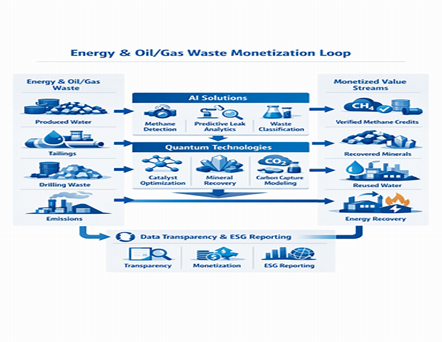
Quantum computing isn’t about faster spreadsheets — it’s about solving optimization and chemistry problems classical computers can’t touch.
A. Quantum Optimization of MRFs
Quantum algorithms optimize:
- Conveyor speeds
- Robotic picking sequences
- Sensor placement
- Energy usage
- Material flow routing
Result: 20–40% higher recovery rates, 15–25% lower energy consumption.
B. Quantum Chemistry for Waste‑to‑Value
Quantum simulation accelerates:
- Plastic depolymerization
- Chemical recycling pathways
- PFAS destruction
- Biogas yield optimization
- Conversion of organics into high‑value chemicals
Punchline: “Quantum computing cracks the chemistry that keeps waste from becoming value.”
C. Quantum‑Enhanced Circular Supply Chains
Quantum models map:
- Material flows across cities
- Optimal reuse loops
- Reverse logistics networks
- Carbon‑minimized transportation routes
This enables circularity at national scale.
The New Waste Monetization Model
AI + quantum unlock four major revenue streams:
1. High‑Value Material Recovery
Rare earths, metals, high‑grade plastics, construction materials
2. Energy & Fuel Production
Biogas, hydrogen from organics, synthetic fuels from plastics, waste heat recovery
3. Carbon & Methane Credits
AI‑verified measurement enables:
- Verified methane capture
- Carbon‑negative waste‑to‑energy
- Transparent reporting for regulators and investors
4. Data‑as‑a‑Service (DaaS)
Waste becomes a dataset sold to:
- Manufacturers
- Municipalities
- ESG auditors
- Commodity traders
Punchline: “The next billion‑dollar waste company will be a data company disguised as a recycler.”
Governance, Compliance & Trust
AI and quantum introduce new governance responsibilities:
- Transparent audit trails
- Bias‑free decision systems
- Cybersecurity for sensor networks
- Data sovereignty and cross‑border compliance
- Quantum‑safe encryption for critical infrastructure
North America will require harmonized standards to ensure:
- Interoperable data
- Shared emissions baselines
- Cross‑border material recovery markets
Punchline: “Trust will be the currency that determines who runs the circular economy.”
The 2035 Vision: A Fully Intelligent Waste Ecosystem
By 2035, North America could operate a continent‑wide intelligent waste system:
- Every bin sensorized
- Every truck autonomous or AI‑optimized
- Every landfill a monitored bioreactor
- Every MRF quantum‑optimized
- Every material with a digital passport
- Every municipality with real‑time dashboards
- Every producer paying based on actual lifecycle impact
Punchline: “Waste disappears — replaced by a continent‑wide resource recovery engine.”
What Leaders Must Do Now
Executives, regulators, and operators should focus on:
- Build AI‑ready infrastructure Sensors, data pipelines, standardized reporting
- Pilot quantum‑ready optimization problems Routing, sorting, energy optimization
- Create cross‑sector partnerships Energy, agriculture, manufacturing, aviation, waste
- Establish transparent governance frameworks Auditability, explainability, compliance‑by‑design
- Monetize early wins Biogas, plastics recovery, carbon credits, data services
“The future belongs to the operators who move first, scale fast, and govern well.”
AI and quantum computing won’t modernize waste management — they will redefine it. The industry is shifting from hauling and disposal to intelligence, chemistry, and monetization. North America can lead the world in circular resource recovery, but only if leaders embrace the technologies that turn waste into value.
“In the next decade, waste won’t be thrown away — it will be mined, measured, monetized, and transformed.”
“The Waste Awakens: AI + Quantum and the Rise of the Circular Superpower”